West Coast Business Trends
Hope Prevails On The West Coast Despite Turbulence

By Zach Miller
At the time of this writing, North American lumber prices have seen a 1.5 percent year-over-year increase with moderate spring activity. West Coast manufacturers are dealing with a myriad of issues including fiber supply, logistical disruptions and uncertainty over the duty and tariffs. Yet producers interviewed are sharing optimism, at least in the short term, and are hopeful that demand will continue to drive business into the 3rd and 4th quarters. The following is what West Coast producers are saying about the state of their companies and how they see the marketplace:
Dean Garofano of Delta Forestry Group, Pitt Meadows, BC, said, “The markets have been slow the first few months of 2026. The U.S. economy is still struggling, which has led to a reduction in consumer spending. The winter weather did not help, as many areas were still dealing with snow and cold through March.
“Duties and tariffs continue to be prohibitive for sales and margins and now the current war with Iran is increasing prices and uncertainty. We are already seeing freight rates increase and higher oil and freight prices are impacting many parts of the economy — including manufacturing and logging costs.
“Here at Delta Forestry Group, we managed to still have a decent quarter for sales thanks to some loyal and strong partnerships. We are hoping to continue our momentum for the next three or four months but looking past that timeline is concerning. With the end of the Iran war uncertain, over 45 percent duties and tariffs and the USMCA up for renewal this summer, there are a lot of factors out of our control that continue to have big impacts on our industry.”
Garofano continued, “On the supply side, logs continue to be difficult to source on the West Coast. This may become worse if this war continues, as many more logging blocks are becoming uneconomical due to rising manufacturing costs due to the elevated oil prices. The scarcity of Hemlock and Cedar logs has made it difficult for sawmills to source, resulting in increased log prices while lumber prices continue to be stagnant. On a positive note, we are expecting the preliminary determination for AR 7 any day now and the new duty rate is expected to come in lower than the current duty rate. The final determination will be announced later this year when the new rate will become effective. Should the preliminary rate come in lower, it would be some good news needed in this challenging environment.”
John Mcdowell of Oregon Industrial Lumber Products, Springfield, OR, said, “Balance between demand and supply is weird. In the world of upper end clears, there are excess narrows available to the market, but when it comes to wides, they are very hard to find. However, just because the wides are tough to come by demand is overall still on the low end of where we would like things to be.
“So, the disconnect is that sawmills want more for the material because supply is tight while customers are not super interested — especially when we tell them that it’s more expensive than the last time they picked some up. If circumstances have not picked up by the time this is in print, there will have likely been some serious push back on mills for pricing from wholesalers and reman companies.
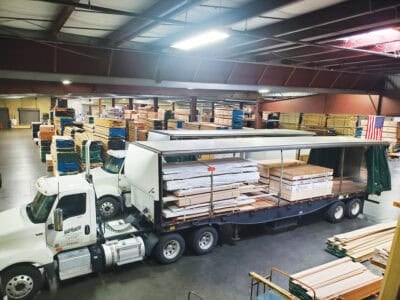
A variety of issues such as fiber supply, logistics, duties, tariffs and the Iran war are affecting the West Coast softwood market.
“On knotty products, supply outnumbers demand. Pricing seems to be bouncing up and down regardless how much material is sold. My order file finally began to wake up in late February/early March. Whether that is a temporary bump, or the beginning of the market waking up, will be determined in the upcoming month or two.”
Mcdowell continued, “With the various economical and political chaos that is going on at the time of this writing, it’s hard to explain why there was an improvement at all, so it’s tough to tell if these distractions will affect the market going forward or not. Obviously, if the interest rate was to be decreased it would help but that currently looks unlikely in the short term.
“Our customers moods are improving but they are still cautious. They are also seeing an uptick, but they are not at a point where they want to inventory quantities they have in the past. Most quotes that turn into orders over the first quarter are ones that took many weeks or even months to pin down and get a PO on. An order takes a lot more work both for us and our customers to close on currently. Around half of our current orders are ones that we may have had to requote once or twice due to time passing after the initial quote.
“The fuel disruptions in price and availability will likely hurt order quantity overall because companies will not close on quotes where they have to pass on high shipping expenses on small orders. I expect the oil problems to at least be around till June if not longer.
“What I can’t tell is whether the market will improve despite the shipping increased costs or if that will become a factor leading to returning to a painfully slow market.” Mcdowell finished by saying the following. “Overall, I see a meaningful amount to consolidation in lumber products in the last eight months. I expect that this will change markets over time. In our specialties we also see the issues created by less wood coming across the border from Canada due to both high duties and Canadian political issues affecting their own lumber products industry. There will also be some interesting effects that take place in the West Coast DF timber market once Sierra’s timber mill in Eugene, OR, starts to run at full capacity. Good or bad it will have not only affect the timber market but on the mills who also make lots of our U.S. DF clears. Not everything is negative but it’s a period of lots of large swings up and especially down. I think it’s also a period where if you can survive the chaos there will be less competition to deal with on the back end. Let’s hope that by the time you’re reading this it’s more than just a temporary increase in the market.”
Landon Erbenich of Selkirk Cedar/Downie Timber, Revelstoke, BC, said, “The customary price cycle leading into early spring has been notably muted, largely due to prevailing market uncertainty. Weather conditions across key regions have deferred demand into late April and May, extending through the summer months rather than following the traditional March lift. In response, key customers have been proactively supported with committed volumes positioned for the anticipated seasonal upswing, secured at competitive price levels. Whether the market ultimately meets these expectations remains to be seen.
“Labor continues to be a persistent challenge across British Columbia, as the cost-of-living pressures within the province have shown little sign of easing over the past year. While reaching a mutually beneficial trade framework with the U.S. market remains a critical longer-term objective, the more immediate concern lies in rising fuel surcharges around seven to 10 percent, of which will continue to climb.”
Erbenich continued, “These increases translate directly into higher costs for end users, with little opportunity for mitigation. Amid global supply adjustments, innovation around species mixes within the province has reached unprecedented levels. Producers are increasingly compelled to explore alternative options and cultivate new markets where possible. British Columbia is not alone in facing constraints on high-quality fiber supply. The demand for premium lumber—characterized by tight grain, intergrown knot structures, and dimensional stability—remains strong, yet only a limited number of regions worldwide possess the natural attributes required to consistently produce such material. Canada is one of them.”