Integration, Discipline And Stewardship Drive Thompson Appalachian Hardwoods
“What we can do is stay in our lane, produce the best product we can, and remain relevant where hardwood truly belongs.” – Nordeck Thompson, founder and chairman of the board, Thompson Appalachian Hardwoods Inc.
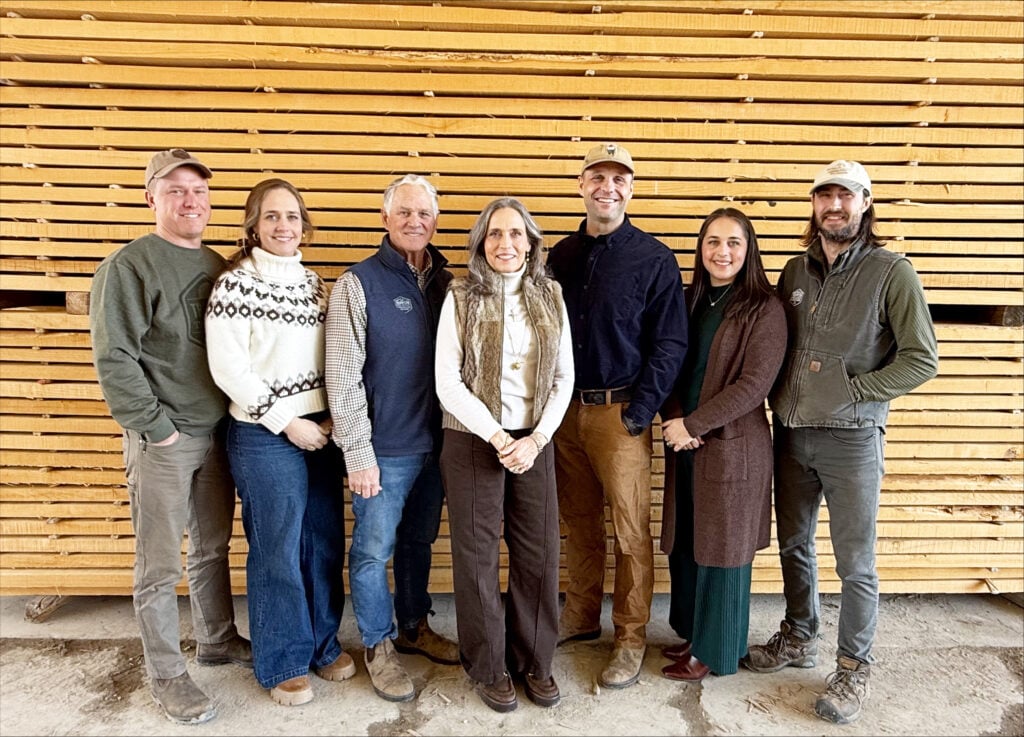
Members of the Thompson family are pictured together, from left to right: Drew Getty, Claire Getty, Nordeck Thompson, Mary Claire Thompson, Nick Thompson, Mary Lee McConnell, and Rob McConnell.
Thompson Appalachian Hardwoods Inc., headquartered in Huntland, TN, has grown steadily from a small, family-run sawmill into a vertically integrated hardwood manufacturing operation focused on quality, consistency and long-term relevance. Founded in 1993, the company employs more than 130 people and operates across approximately 115 acres, serving customers in domestic and international markets with a wide range of appearance- and industrial-grade hardwood products.
Thompson Appalachian Hardwoods produces approximately 30 million board feet annually across its operations, with a species mix led by Red and White Oak, followed by Poplar, Ash, Walnut and select mixed hardwoods. Production is heavily weighted toward thicker stock, reflecting a deliberate strategy to avoid commodity-grade volatility and focus instead on higher-margin, harder-to-replace products.
“We really try to limit how much 4/4 we produce,” said Claire Getty, chief financial officer. “Our focus has been on thicker stock and longer-turn items that better match both our timber resource and our customers’ needs.”
Red and White Oak remain the company’s primary species, with production centered on 5/4, 6/4 and 8/4, particularly in White Oak, where 8/4 has become a core specialty. Walnut production is focused on 6/4 and 8/4, supported by on-site steaming and controlled drying. Poplar production includes 4/4 through 6/4, largely for moulding and millwork applications, while Ash, still available in the region despite Emerald Ash Borer pressures, is produced primarily in 5/4 and 6/4.
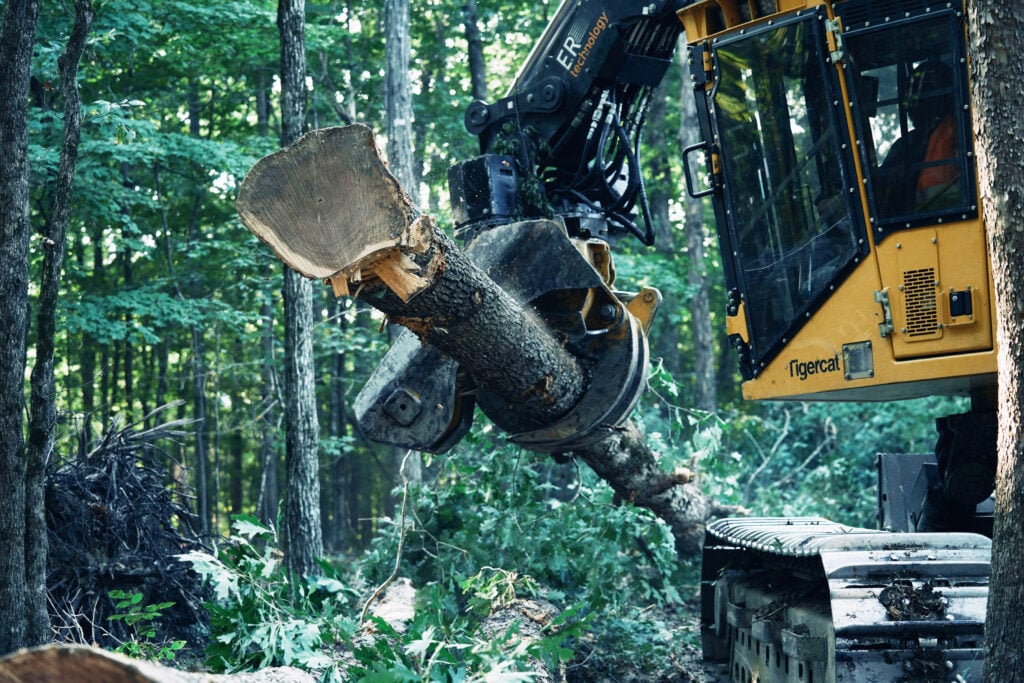
Timber is harvested using a Tigercat 830 track cutter operating in the working forests of Southern Appalachia.
The company’s roots trace back to Nordeck Thompson, founder and Chairman of the board, whose family history in forestry and sawmilling stretches back several generations in Georgia. After stepping away from the industry for a period, Nordeck returned with a clear strategy: locate a mill in the heart of privately owned timberland capable of producing higher-grade hardwood logs.
That search led the family to southern Tennessee, where the Appalachian foothills offered access to high-quality hardwood timber suitable for appearance-grade products such as furniture, millwork, moulding and flooring.
“This mill was never meant to be the biggest,” Nordeck explained. “It was meant to be in the right place, producing the right products, with enough control to manage quality and risk.”
Nick Thompson, president, joined the business alongside his sister, Claire Getty, as the company began to expand beyond its original green lumber focus. As the company grew, leadership began to emphasize a long-term operating model built around control of quality, markets and logistics rather than sheer scale.
Over time, Thompson Appalachian Hardwoods has evolved into a vertically integrated forest products company, adding dry kilns, industrial milling capacity, logging operations, land management and trucking under one umbrella. According to leadership, integration has been approached deliberately as a way to reduce exposure to market swings while maintaining flexibility for customers.
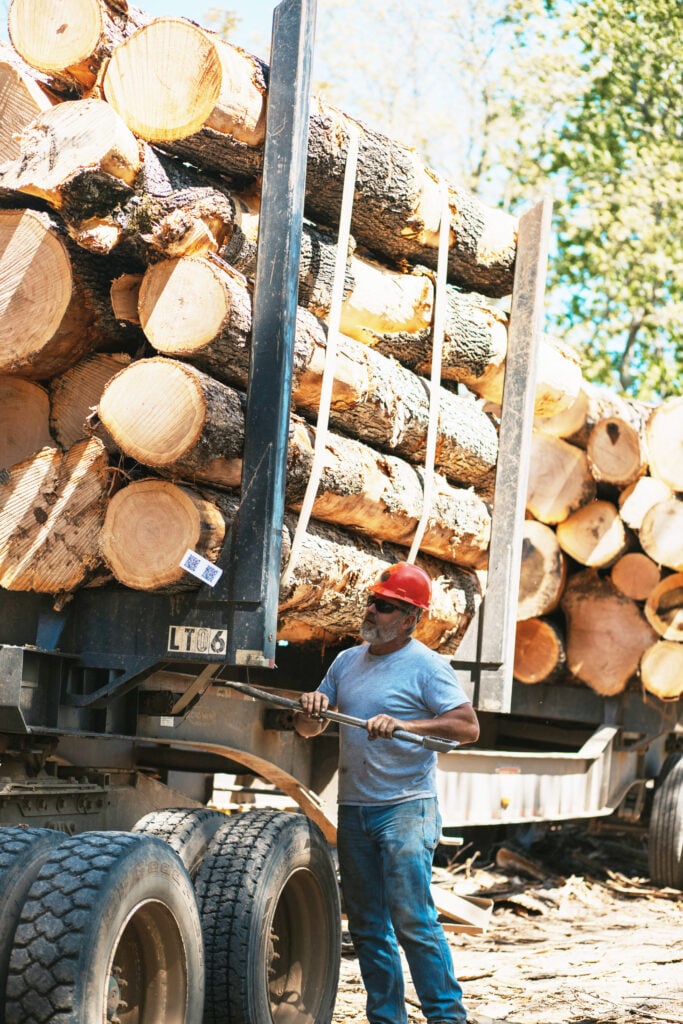
A fully loaded log trailer is tagged, geo-referenced and prepared for transport to the mill.
Today, the company operates more than one million board feet of kiln capacity across 13 dry kilns, supported primarily by wood waste, fired boiler systems. Additional redundancy is built into the system through backup gas-fired and electric kilns, allowing flexibility based on species and drying requirements.
“We dry a high percentage of what we produce,” Nordeck said. “Green sales are primarily limited to industrial products like crossties and pallet material. If there’s an opportunity to add value through drying and it makes strategic sense, we have the capacity to do that.”
That philosophy extends beyond drying. In 2025, the company bought two Hurdle tie mills, significantly expanding its industrial capacity and allowing more utilization of the timber resource. The tie operation alone is capable of producing 250,000 to 300,000 board feet per week on two shifts, contributing meaningfully to overall production while supporting domestic markets.
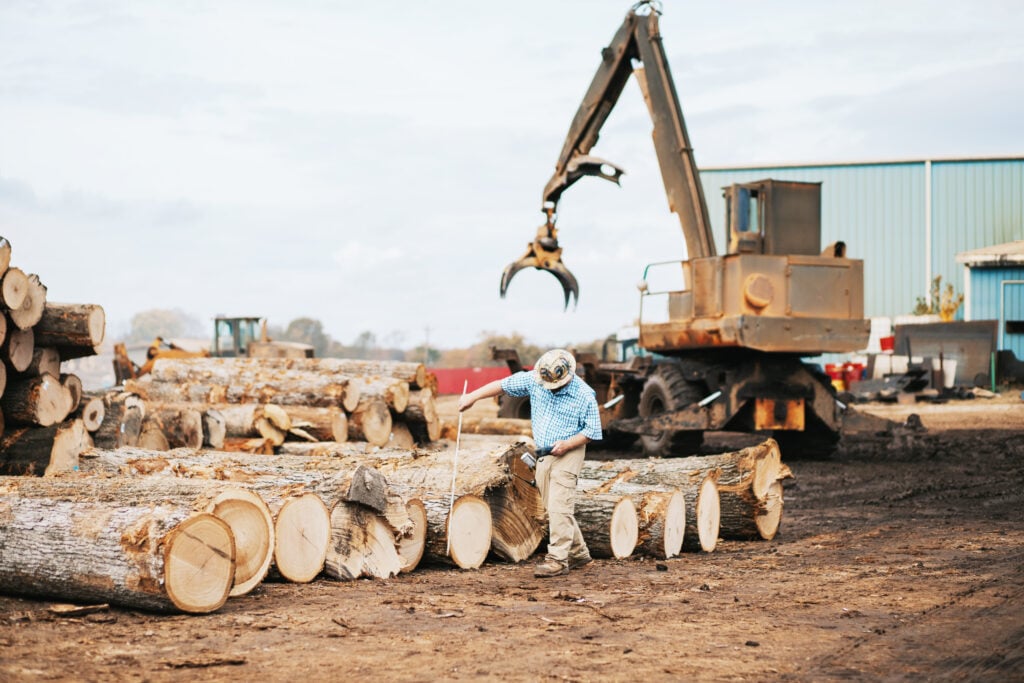
Inbound logs are carefully scaled, tagged and entered into inventory upon arrival at the facility.
Integration, according to leadership, is not about chasing size but about controlling variables that can destabilize a business, markets, logistics, quality and inventory.
“If you’re not careful, you can invest your way into trouble,” Nordeck said. “Integration only works if it supports your supply chain and your customers without turning you into their competitor.”
Operational discipline remains a cornerstone of the company’s approach. Rob McConnell, vice president of operations, oversees daily production with an emphasis on consistency across thickness, grade and finish. Rather than relying on periodic checks, the operation monitors standard deviation continuously across sawing centers using micrometers rather than tape measures.
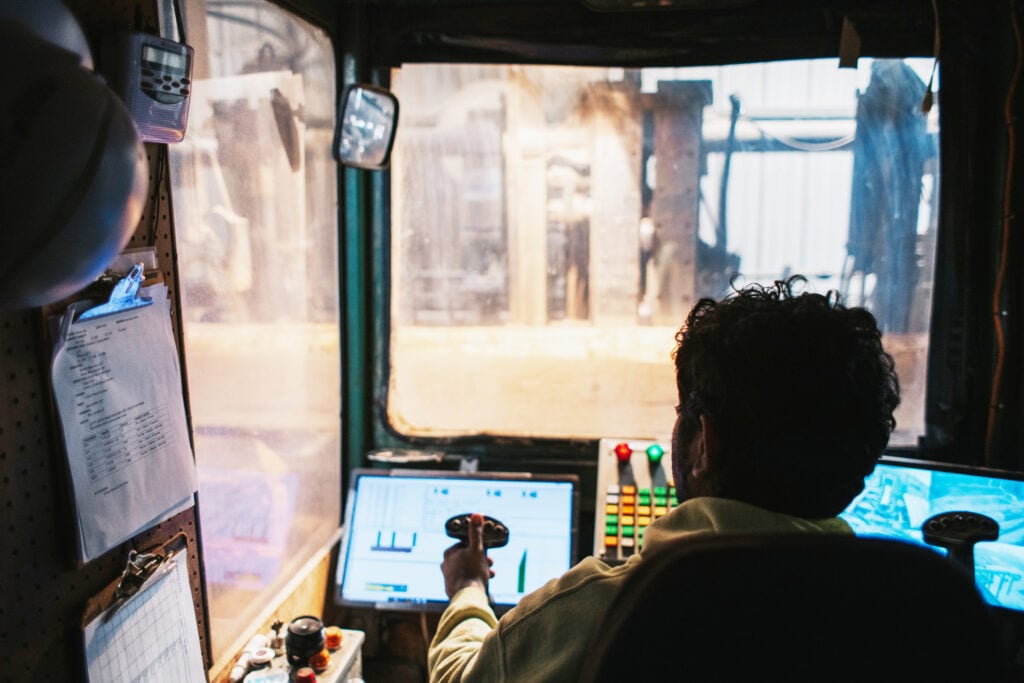
This view from the grade sawmill highlights the Salem Equipment optimized carriage system with a seven-foot double cut headrig in operation.
“Quality can disappear in minutes if you’re not watching it,” Nordeck said. “A sliver behind a guide can change everything.”
The company’s yard practices reinforce that focus. Lumber is end-coated, treated with antifungal and brightening agents, and stacked on fluted stickers to promote airflow and minimize stain. Thicker stock is protected with SHADE-DRI® to close the air flow and help eliminate checking material and topped during longer air-drying periods before entering the kilns.
“These are small details, but they add up,” Getty said. “Our customers expect flat, straight, clean lumber that works in their applications.”
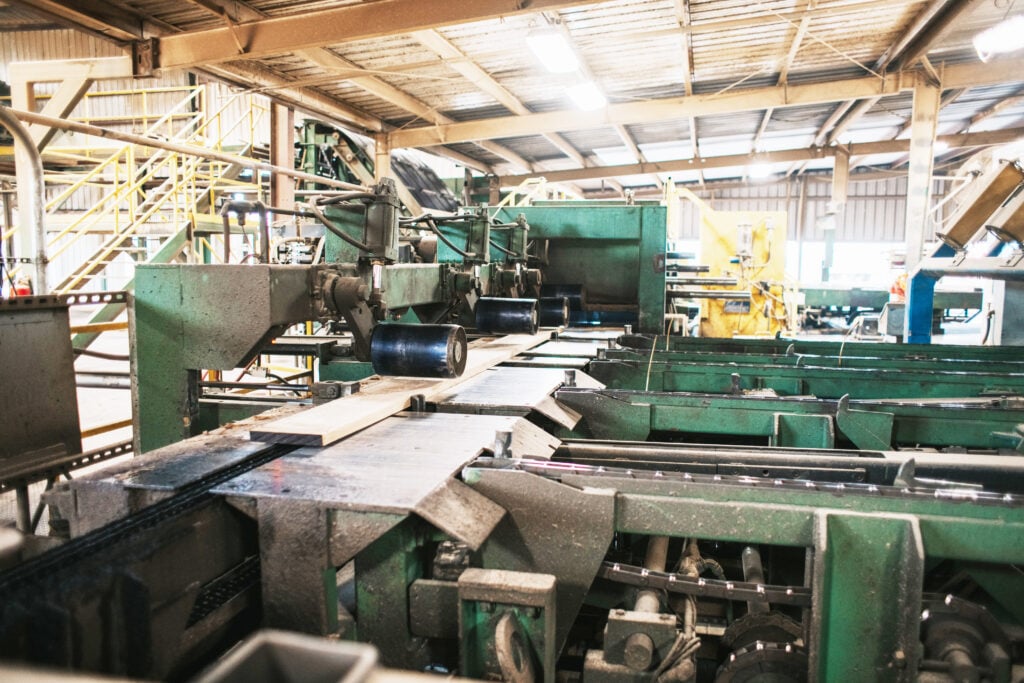
Lumber edging is completed with the Schurman Machine Works optimized edger for maximum efficiency and precision.
Thompson Appalachian Hardwoods serves a mix of domestic and international customers, including flooring manufacturers, furniture producers, moulding and millwork companies, distributors and industrial buyers. While exports once accounted for a larger share of sales, the company’s recent investments have shifted the balance closer to domestic markets.
Today, sales are approximately 50 to 55 percent domestic, with the remainder export, depending on product mix and market conditions.
“Our focus is on value, not just volume,” Getty said. “Some products move a lot of footage but carry less value. Others are slower but more strategic.”
The company works directly with customers where possible, limiting reliance on intermediaries, while remaining flexible in regions where exporters or agents are necessary. All sales are handled in truckload quantities, with custom packaging and branding available for distributors.
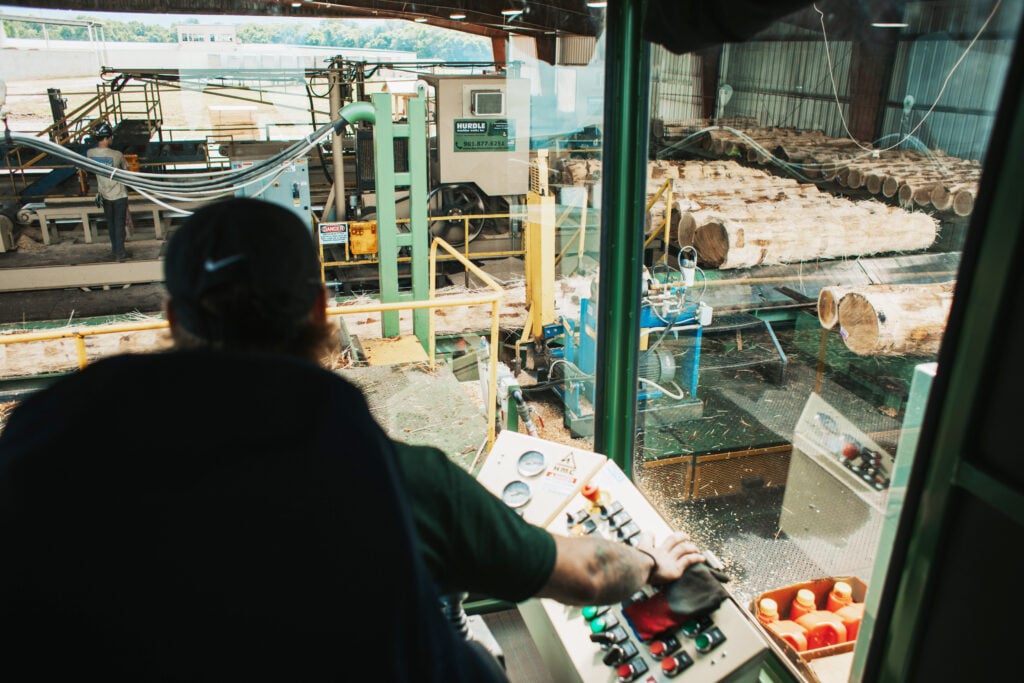
From the HMC debarker, logs are fed into tandem Hurdle circle sawmills as part of the integrated processing line at Huntland, TN-based, Thompson Appalachian Hardwoods.
Throughout its growth, the company’s leadership consistently frames decisions through the lens of stewardship of capital, people and timberland. Faith and long-term responsibility play a role in how the company evaluates risk, investment and growth.
“We see this as a relay race,” Getty said. “You pass the baton, but you also trust the next runner.”
For Nordeck, stewardship extends beyond the mill gate to landowners and loggers whose livelihoods depend on viable end markets.
“Our responsibility doesn’t stop with buying logs,” he offered. “If the grower can’t monetize that land, it gets converted to something else. Everything we do is tied back to keeping that forest productive and relevant.”
As markets evolve and substitution pressures increase, Thompson Appalachian Hardwoods has chosen a path defined by specialization, integration and restraint.
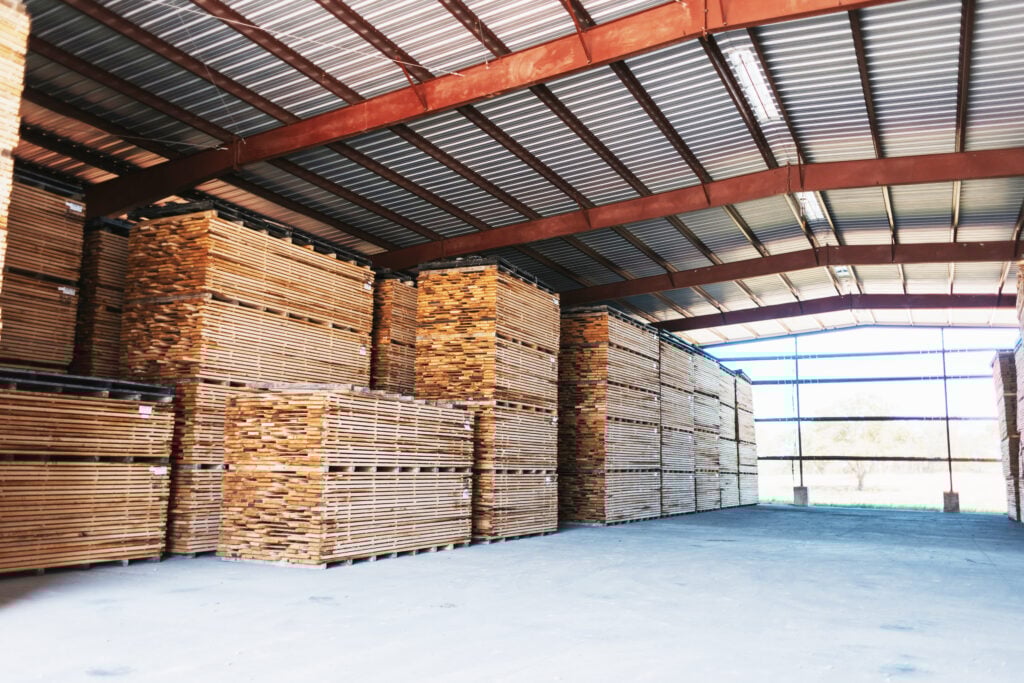
Thick-stock lumber is stacked and drying in the shed as it is prepared for the next stage of production.
“We don’t believe we can turn the whole ship around,” Nordeck said. “What we can do is stay in our lane, produce the best product we can, and remain relevant where hardwood truly belongs.”
For a company that has weathered decades of cycles, that clarity may be its greatest asset.
Thompson Appalachian Hardwoods Inc. is a member of the National Hardwood Lumber Association, American Hardwood Export Council, Hardwood Manufacturers Association, Tennessee Forestry Association and the Southern Cypress Manufacturers Association.
For more information, visit thompsonappalachian.com.