New report explores how mass timber schools could boost well-being, cut carbon, and remain flexible without breaking the bank.
How can we build schools that are adaptable, while supporting student well-being and learning? What role can biophilic design and mass timber play? And how do we cut carbon, while delivering better schools faster, without breaking the bank?
Those are the questions the integrated design firm, Mithun, set out to explore in their report, Mass Timber Schools: Building for Wellness, in collaboration with a team of experts.
As expertise and experience in mass timber continues to flourish across the country, an increasing number of designers are looking at how mass timber and biophilic design could help optimize learning environments. And according to the report, there is a growing body of research that associates biophilic spaces with student health and cognitive benefits. Combine that with advancements in mass timber technology, and you have a winning combo that can contribute to building better schools, faster.
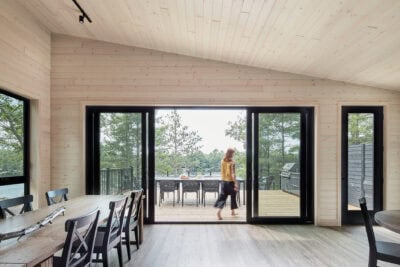
To further investigate the feasibility of mass timber schools, the team took an iterative approach driven by an optimized three-ply mass timber structural grid and sectional framework that balances efficient timber fiber volumes with the need for agile spaces. The report’s results demonstrate that mass timber spaces can be cost competitive for schools when compared to a steel-framed baseline—providing warm, well-daylit interiors with exposed mass timber columns, beams, ceilings, and walls that can evoke biophilic responses while significantly reducing embodied carbon impacts. According to the Mithun report and cited studies, there is growing evidence that biophilic design can be correlated with improved learning, memory, emotion, and social intelligence. Biophilic design is when designers bring elements of the outdoors inside by integrating natural elements into the building, such as wood, greenery, natural light, water features, and views to nature. Children with access to nature exhibit lower levels of stress than those without; children in day-lit classrooms have test scores 7-18% higher, while children without daylight saw test scores drop by 17%.
Similarly, exposure to wood in indoor environments has been correlated to positive biophilic responses. Preliminary research shows wood surfaces reduce activation of the sympathetic nervous system, helping to calm the body before the onset of stress. Other studies suggest wood may help reduce blood pressure and heart rate, as well as allowing for more creativity and productivity.
All claims cited in this article are from the Mithun report.
Read Think Wood’s coverage of the study and download the document by going to thinkwood.com/blog.