
Built-to-Spec Millwork On Demand At Tilo Industries
“Architects dream of it; our crew figures out how to machine it, bend it, clamp it and finish it,” -Tim Yoder, owner and president, Tilo Industries LLC
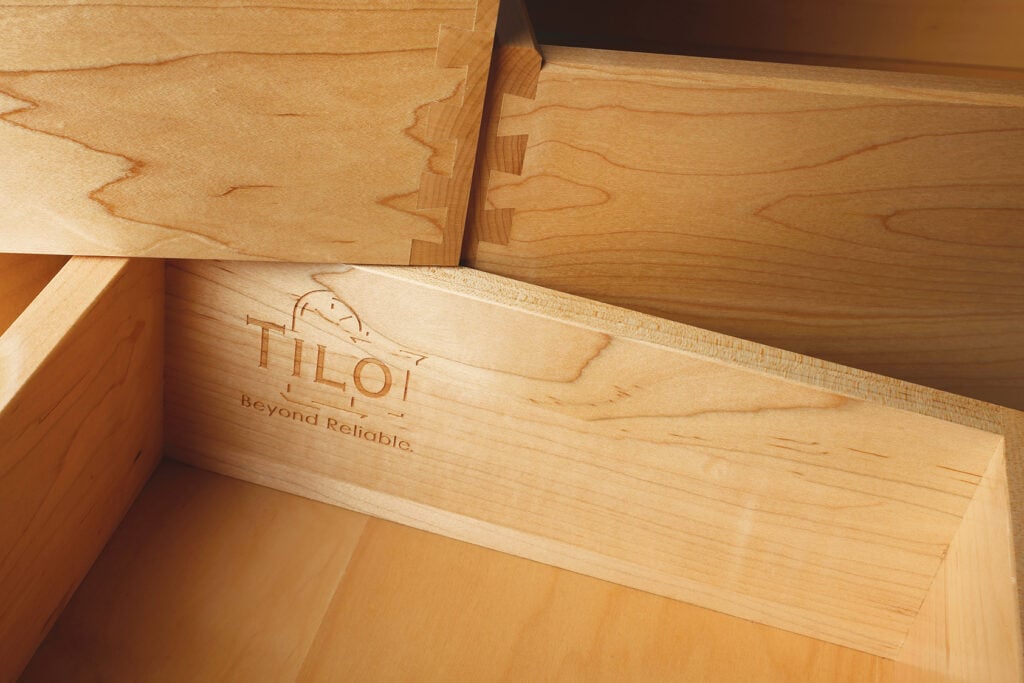
Prefinished, dovetail drawer boxes produced by Tilo Industries.
Tilo Industries LLC of Lewisburg, PA, operates out of roughly 60,000 square feet of production and finishing space, yet the family-owned firm moves wood the way a contractor pours concrete—fast, accurate and to spec. Owner and President Tim Yoder puts the company’s annual appetite at “right around 1.4 million board feet, predominantly 4/4 through 8/4 in No. 1 Common and FAS.” The species list includes, according to the company website for architectural accents, selected imports such as European White Oak and Sapele Mahogany, in addition to Hard and Soft Maple, Poplar, Walnut, Red and White Oak (flat, rift and quartered), Ash, Basswood, Cherry, Hickory and Birch. “Whatever the architect puts on paper, we’ll source and machine. Our job is to say yes and go get the wood,” Yoder said.
Tilo opened its doors in August 1998 with two employees, one small building and more grit than cash flow. “The first four years were brutal—too little work one week, too few hands the next,” Yoder recalled. Growth turned the corner when an outside-sales partner joined the team: “Orders spiked, and suddenly we were racing infrastructure just to keep up.” Four additions later, the original shop has been joined by an 11-acre finishing campus where priming, custom stains and top-coat work now happen under one roof. The expansion coincided with a widening customer footprint. What began as a hometown millwork supplier now ships mouldings, edge-glued panels, CNC-machined parts and drawer boxes up and down the East Coast and into the Midwest, “really all over the U.S.,” Yoder noted. Online, the company markets itself with the tagline “Beyond Reliable,” language that surfaced after interviews with longtime buyers. “We’re proud people describe us that way,” he said. “It sets a high bar, and we have to clear it every truckload.”
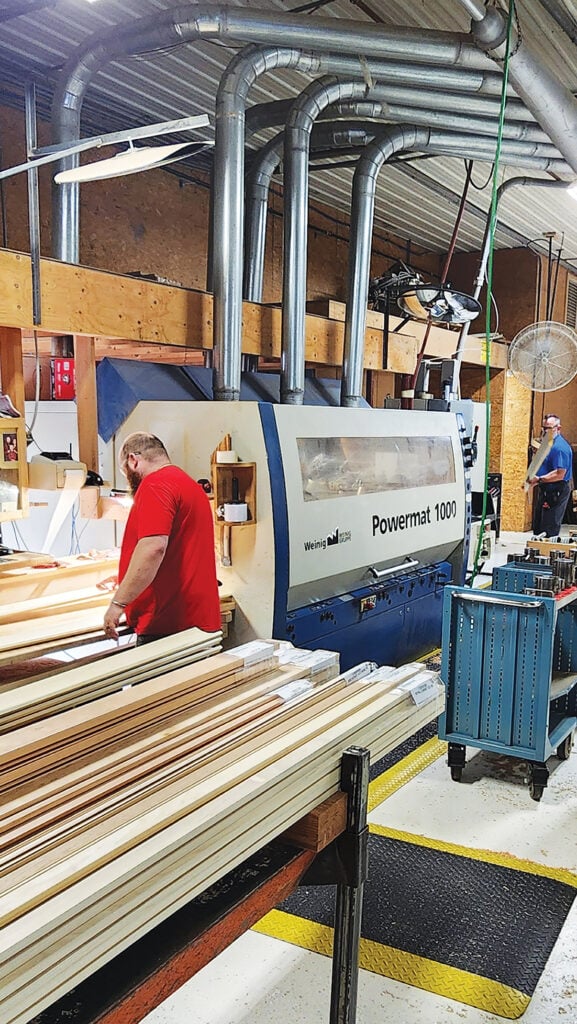
One of Tilo’s three moulders producing moulding to their customers’ specifications.
Inside the main mill, production muscle centers on three Weinig moulders fed by a Raiman rip system and a Weinig optimizing cross-cut saw for yield. Multiple straight-line saws supply panel edge-gluing lines anchored by a James L. Taylor clamp carrier and a Costa 52-inch wide-belt sander. Specialty work runs through an Anderson America CNC router, a Mereen-Johnson CNC dovetailer and a J. Schneeberger Maschinen AG CNC knife-grinder that profiles tooling in-house. Plant staff report the machining center routinely holds plus-or-minus five-thousandths on profile work, critical when matching century-old trim in Manhattan brownstones.
With only 28 employees, cross-training is mandatory, allowing an operator who runs edge-glue panels in the morning to shift to drawer-box production after lunch. That flexibility underpins Tilo’s calling card: short lead times. “Most customers order job-to-job, no one warehouses moulding anymore,” Yoder said. “We routinely turn complex profiles in five to 10 working days because we keep rough lumber on the floor and knives on file.”
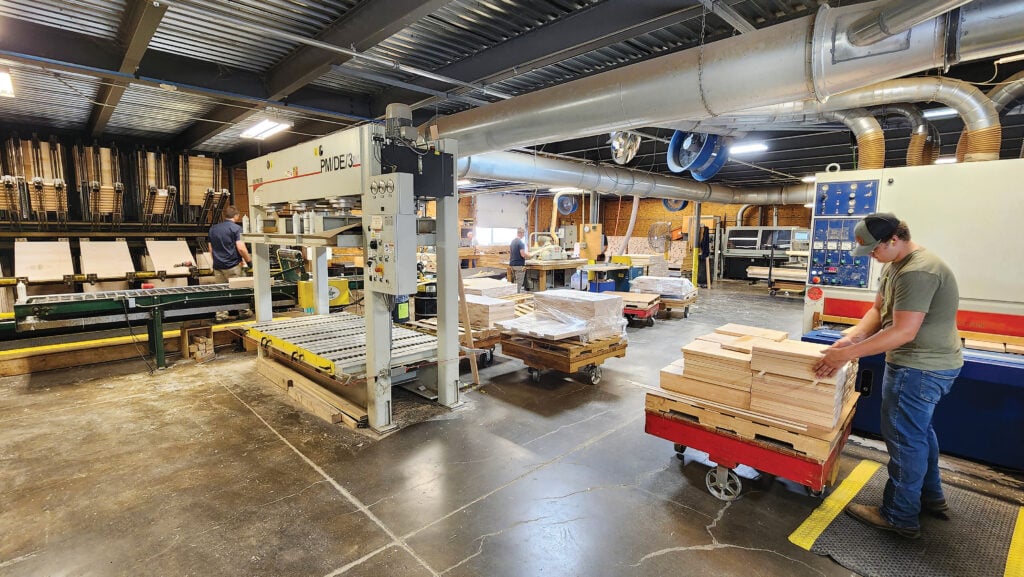
A view into Lewisburg, PA-based, Tilo Industries LLC’s edge glued panel processing area where panels are laid up and finish sanded per customer specs.
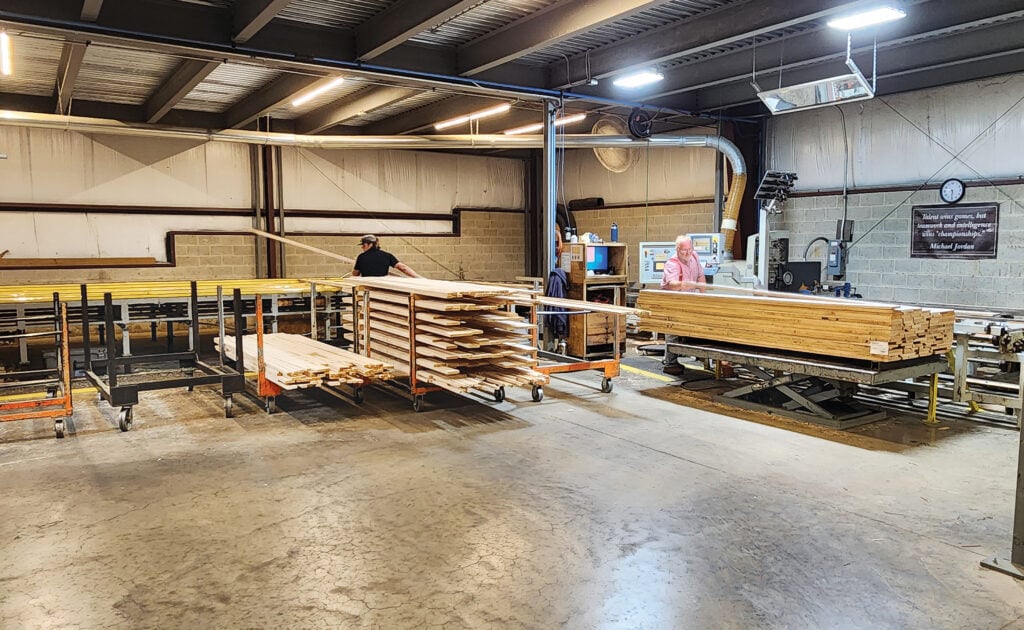
The gang rip area, pictured here, is where rips are prepared for the moulders and some PET parts.
Complexity is where Tilo shines. Recent jobs include a 21-inch crown moulding bent into an 18-foot full circle for a Manhattan office tower and oversized White Oak box beams for a Washington, D.C., hotel renovation. “Architects dream of it; our crew figures out how to machine it, bend it, clamp it and finish it,” Tim said. The firm’s Edge by Tilo line tackles glued-up countertops, laminated stair treads and craftsman-grade panels, while the core brand pumps out thousands of linear feet of architectural running trim each week. An online profile finder lets builders scroll hundreds of standard knives or request completely custom geometry.
Tilo’s most recent capital push produced a second facility dedicated solely to finishing, added two years ago. The extra 11 acres leave room for another manufacturing bay as demand dictates. On the machinery side, the company upgraded to CNC dovetail technology to keep drawer-box tolerances tight. Longer term, Yoder said, “We’ll add more automation on the ripping and scanning end; anything that frees up people to focus on quality checkpoints instead of brute force.”
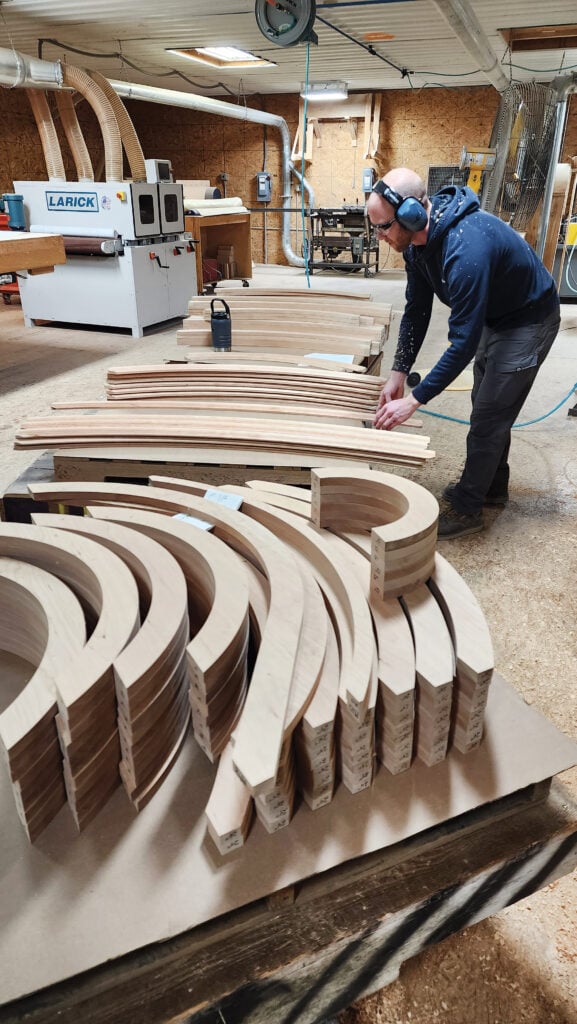
Radius mouldings are produced for a high-end steak house in Washington, D.C.
Labor, however, remains Tilo’s defining asset. “Machines are replaceable; craftsmen aren’t,” he noted. A structured apprentice program rotates new hires through every cell, rip, mould, glue-up, CNC, before assigning a permanent station. The result is a shop floor fluent in both traditional moulding knives and G-code.
Yoder credits the company’s survival to equal parts perseverance and providence. “We faced headwinds any startup knows: thin orders, thin payroll,” he reflected. “God has been good to us, and we try to pass that forward—in how we treat each other here and how quickly we pick up the phone for a customer in a bind.” That ethic is more than talk. When a large Boston millwork house lost a supplier mid-project, Tilo rescheduled its workflow, ran double shifts and delivered the entire package—radius baseboards, S-curved casing and custom drawer fronts—in 10 days. “We knew they were up against liquidated damages,” Yoder said. “Sometimes doing the right thing costs you overtime, but it wins partnerships.”

A high-end, Washington, D.C. millwork project that Tilo Industries produced straight and radius trims for.
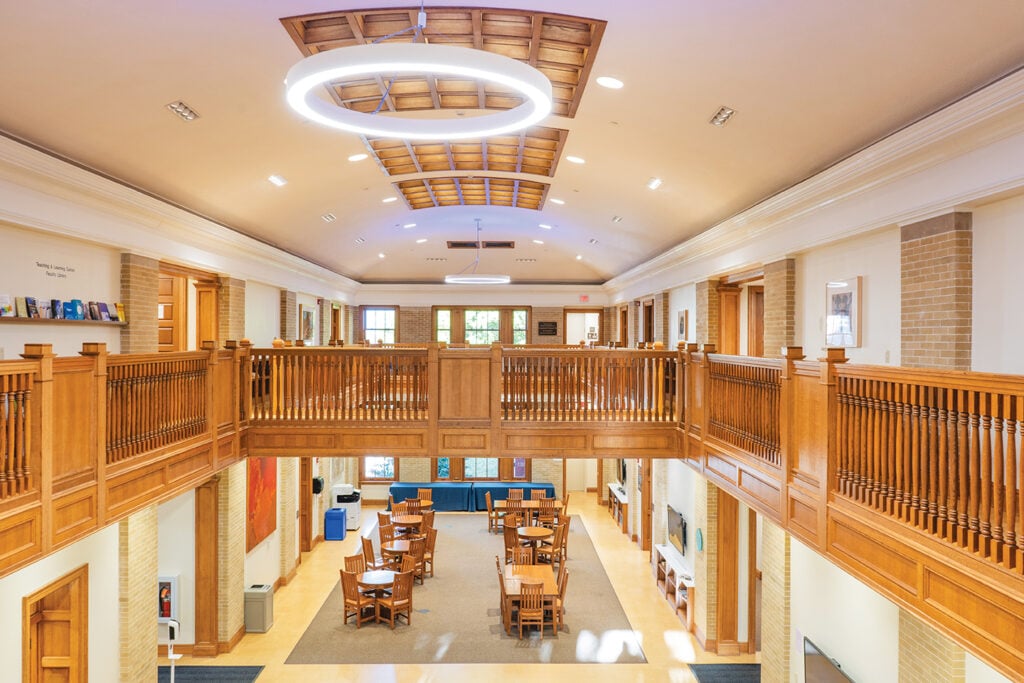
A rift sawn Red Oak project that Tilo produced all the millwork for.
Continuous product-line expansion remains a guiding principle. “We don’t chase new SKUs to fill catalog pages,” Yoder explained. “We add what customers ask for; box beams, primed finishes, CNC cut-outs, then we standardize and scale it.” The firm is also exploring reclaimed and specialty-grain offerings to meet growing design-build demand for sustainable wood.
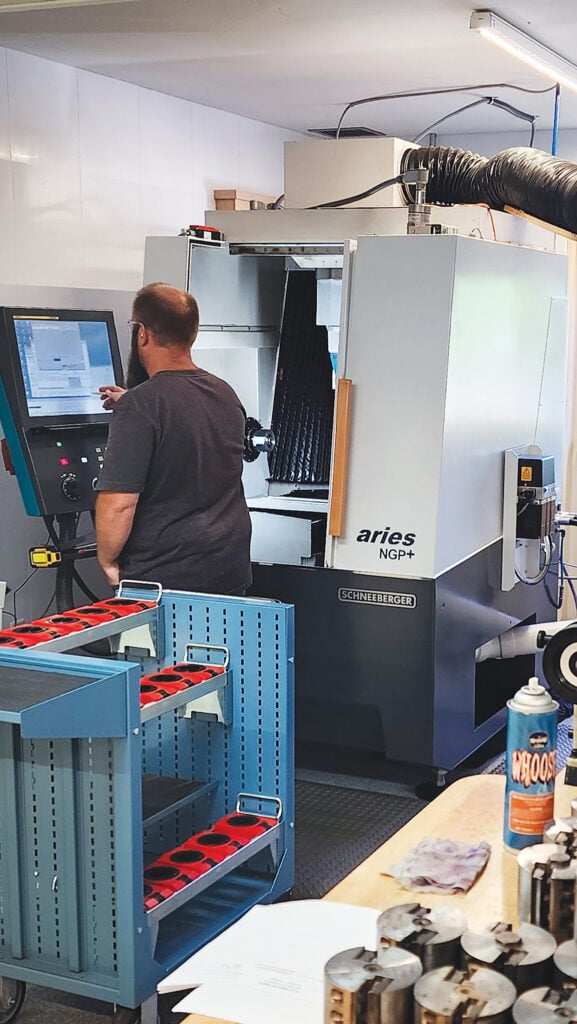
A Schneeberger CNC grinder that prepares the tooling for Tilo’s three moulders.
After 27 years, Tilo Industries shows no signs of slowing. Expanded real estate, a young management bench (Tim’s brother Linus and his son Jared both hold leadership roles) and a supplier network tuned for just-in-time volume have positioned the company as a millwork partner rather than a SKU vendor. “Beyond reliable isn’t a slogan—it’s pressure we put on ourselves,” Tim Yoder said. “A million-board-foot shop in small-town Pennsylvania can compete nationally if every load leaves the gate exactly when we promised in the quote.”
Tilo Industries LLC is a member of the Wood Component Manufacturers Association and the National Wood Flooring Association.
For more information visit tiloindustries.com.