Koetter Woodworking: Reinvesting In People, Processes, And The Future
In an industry where efficiency and consistency separate long-term manufacturers from short-lived operations, Koetter Woodworking has built its reputation on fundamentals that never go out of style: doing what you say you will do, delivering what you promise and surrounding the work with people who care.
Headquartered in Borden, IN, Koetter Woodworking purchases over 30 million board feet annually and runs a predominantly domestic hardwood mix centered heavily on Poplar, along with key species such as Red and White Oak, Cherry and Maple, just to name a few. President Jerry Koetter said Poplar alone accounts for the majority of the company’s production. “Poplar actually is our staple species,” Koetter explained. “It accounts for roughly two-thirds of our overall species mix.”
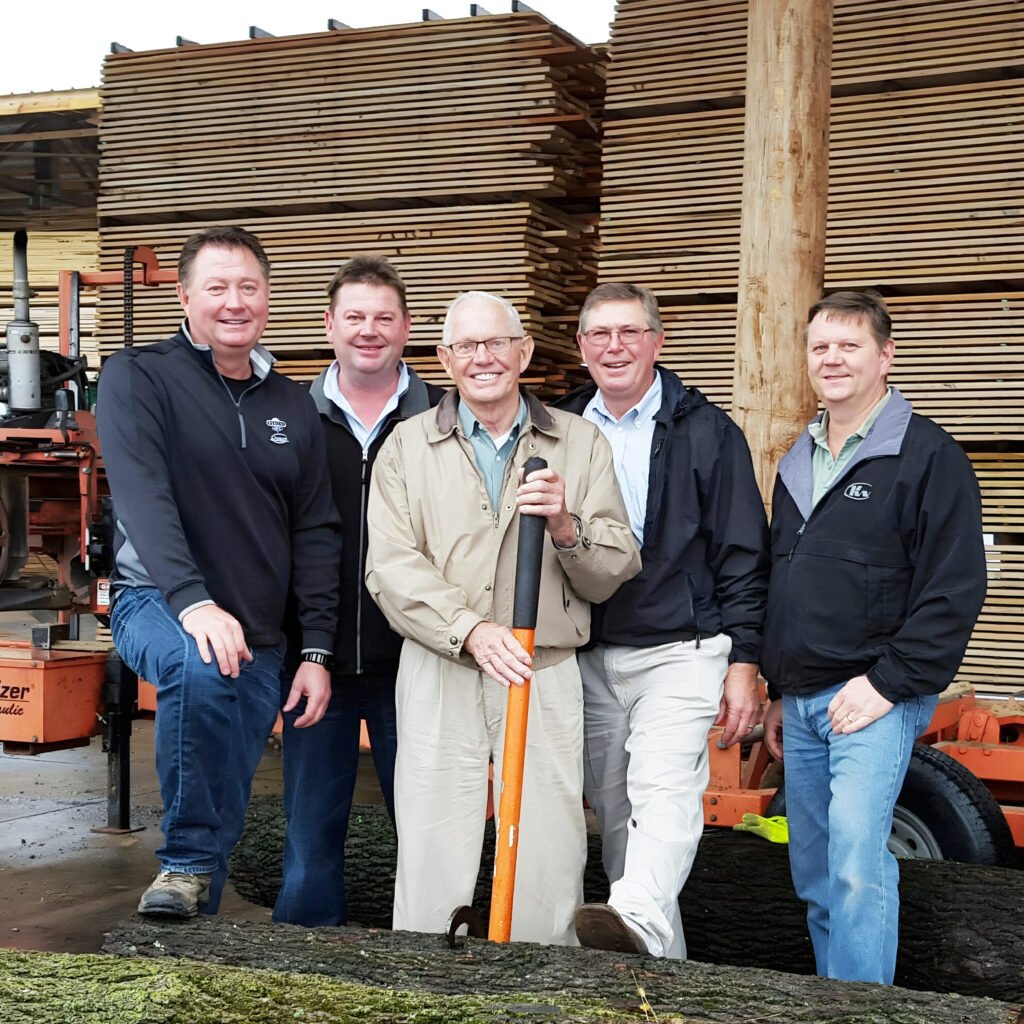
Pictured here are Tom Koetter and his sons from left to right: Jerry Koetter, Brian Koetter, Tom Koetter, Randy Koetter and TJ Koetter.
The company’s Poplar program is largely built around higher-grade offerings. “We focus on higher grade material – typically No. 2 Common and better in Poplar and Select & Better in species like Cherry and Maple,” Koetter stated. Those decisions reflect an approach Koetter has long embraced: focusing on performance-grade lumber that supports dependable manufacturing results for customers who expect consistent yields and clean, high-quality final product.
Koetter’s Poplar program also includes finger-joint Poplar, which allows the company to reclaim material that would otherwise be discarded and convert it into a quality, paint-grade product. The process improves yield, supports sustainability goals, and ensures customers have access to a complete product offering.
“Our mission is to ship a quality product, on time and complete. We take that commitment seriously,”
Jerry Koetter,
President, Koetter Woodworking
Koetter Woodworking’s reputation, however, is not simply the result of species mix or grade strategy. The company’s approach to business is built around the discipline of execution and reinvestment. “Our mission is to ship a quality product, on time and complete,” Koetter said. “We take that commitment seriously.”
Koetter Woodworking remains a family-owned operation. Jerry Koetter is one of four brothers involved in ownership and management, following the legacy built by their parents and the decades of growth the company has experienced since the 1980s.
“The company is owned and operated by the four of us. While there are five of us boys in the family, our brother, Rick, retired from the business in 2012,” Koetter said. Today, the brothers remain involved in daily operations, each leading different aspects of the business. Koetter said his brother Randy serves as CEO, his brother Brian is vice president of sales and marketing, and the youngest brother, T.J., is VP of information technology.
The story of Koetter’s ownership team is tied directly to the company’s operational mindset. Koetter said they began working in the business early, learning the rhythms of manufacturing and the expectations of customers from a young age. “All of us came to work right out of high school,” he said. “We started around sixth grade. That’s when we’d come home from school, spend an hour sweeping floors, come in for dinner, and then head back out for another hour or two to help dad.”
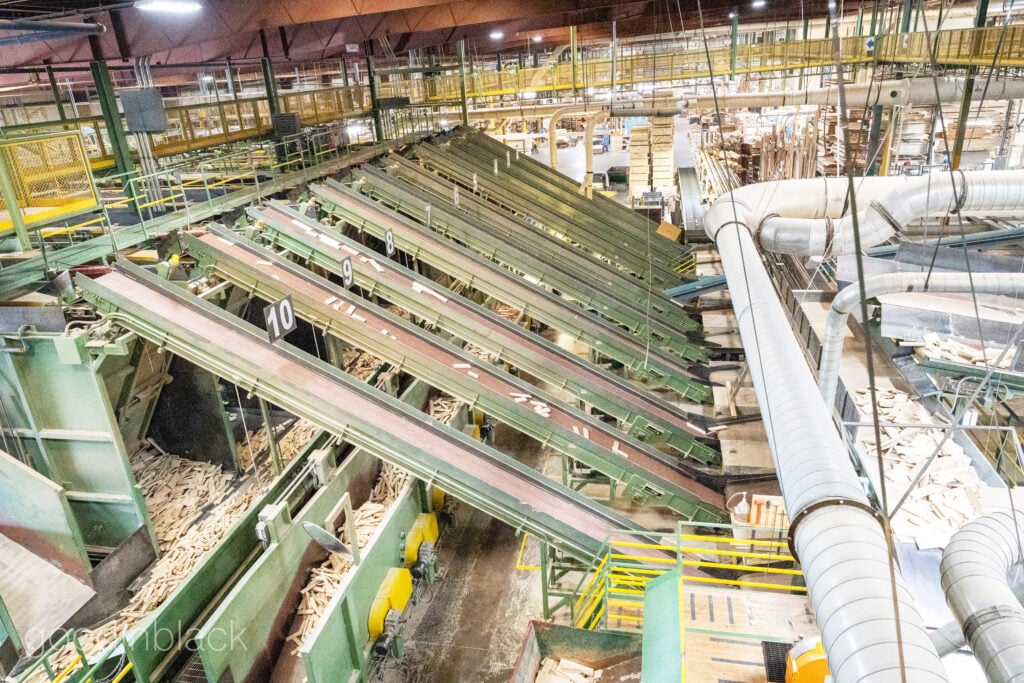
Finger joint production plays a key role in Koetter’s vertically integrated approach, improving yield while maintaining quality standards.
That early experience turned into long-term mastery. Koetter estimates that the combined experience of the brothers totals well into the triple digits.“Between the four of us, we bring more than 130 years of combined experience in the business,” he said. That long runway of hands-on work shows up throughout the company’s structure and culture.
Koetter said his leadership group includes eight directors covering key operational areas such as maintenance, engineering, quality, finance, sales and plant leadership. Beyond that, Koetter noted the company has about 24 managers who keep the business running daily.
Rather than promoting only a handful of leaders as “key personnel,” Koetter said the company’s strength is that it is not dependent on one or two standout individuals “Our strength is the depth of our leadership team. The company doesn’t depend on one or two individuals – it succeeds because of the entire group.” he said.
That emphasis on team is not theoretical. Koetter pointed to the company’s relationships with equipment suppliers as evidence of why culture matters. “One of our signature equipment suppliers is Weinig,” he said, noting Koetter regularly hosts guests from the supplier and works hard to showcase the equipment properly. The deeper point, Koetter said, is that buying equipment is not the same as running it successfully.
“Anyone can purchase advanced equipment,” Koetter said.“But without the right systems and people in place, it won’t perform to its potential.”
Retention is a major differentiator for Koetter. Koetter said the company has more than 40 employees with over 25 years of service. That depth of experience allows Koetter to reinvest with confidence because new technology can be implemented quickly and maintained correctly when the workforce knows the operation from the inside out.
Koetter said the company’s bonus program also supports retention. “We have a pretty robust bonus program, and it keeps people around,” he said. “We’re not necessarily seeking out college-educated candidates. If someone comes in with a good heart, a strong work ethic, and a desire to support their family and get the job done, they tend to stay.”
Koetter said one of the company’s strongest competitive advantages is vertical integration and the ability to execute high levels of customization without outsourcing.
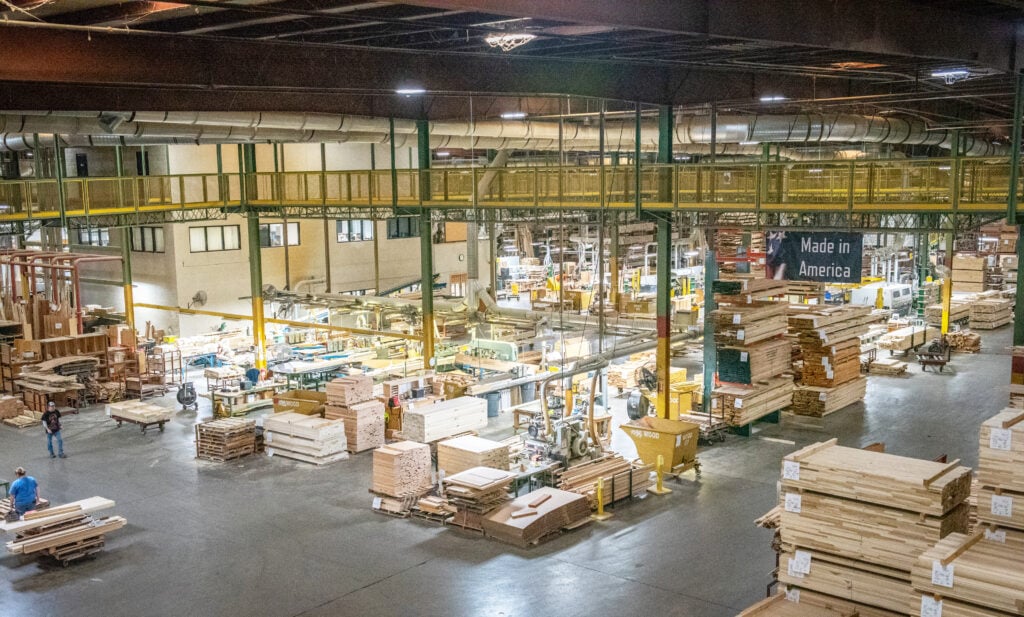
In-house manufacturing allows Koetter to control quality, customization and delivery from start to finish.
“Vertical integration is one of our greatest strengths,” Koetter said. He described a manufacturing approach based on controlling product quality, delivery and customization under one roof. “We specialize in high levels of customization – doors, trim, specialty millwork – all produced in-house under our direct control.” The company’s offering is rounded out with stair components, plywood and cabinet and furniture parts, supported by complementary products from trusted outside partners.
“In addition to our expansive stocking inventory, our structure allows us to respond quickly when customers need custom or time-sensitive work,” he said, describing service speed as a central part of customer loyalty.
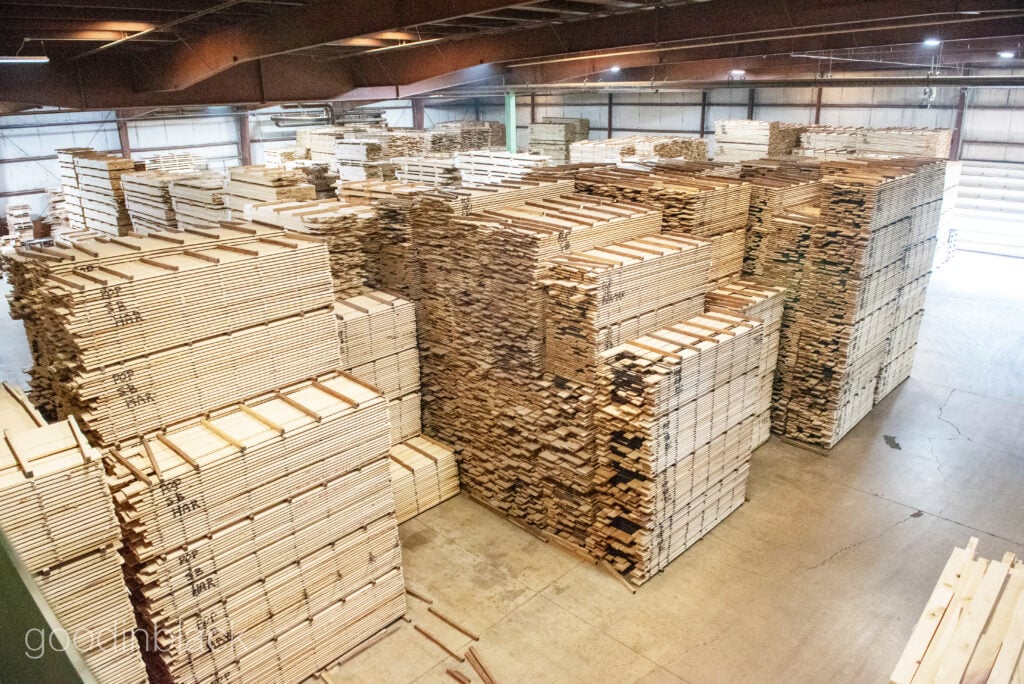
Borden, IN-headquartered, Koetter Woodworking purchases more than 30 million board feet annually,
with Poplar representing the core of its domestic hardwood mix.
That same approach has guided Koetter’s efforts to diversify beyond architectural millwork. Several years ago, the company expanded into rick house components, a product line that aligned naturally with its manufacturing capabilities and operational strengths. Koetter said the move reflects an ongoing effort to explore adjacent markets where the company’s experience in quality, consistency, and scale can translate effectively.
Koetter stressed the company is not competing on the lowest price. “We don’t compete on being the lowest-cost provider,” he said, but added that Koetter’s value proposition is built on quality, on-time execution and control over logistics. The company operates its own trucks and delivers with curtain-side trailers, allowing greater reliability and flexibility.
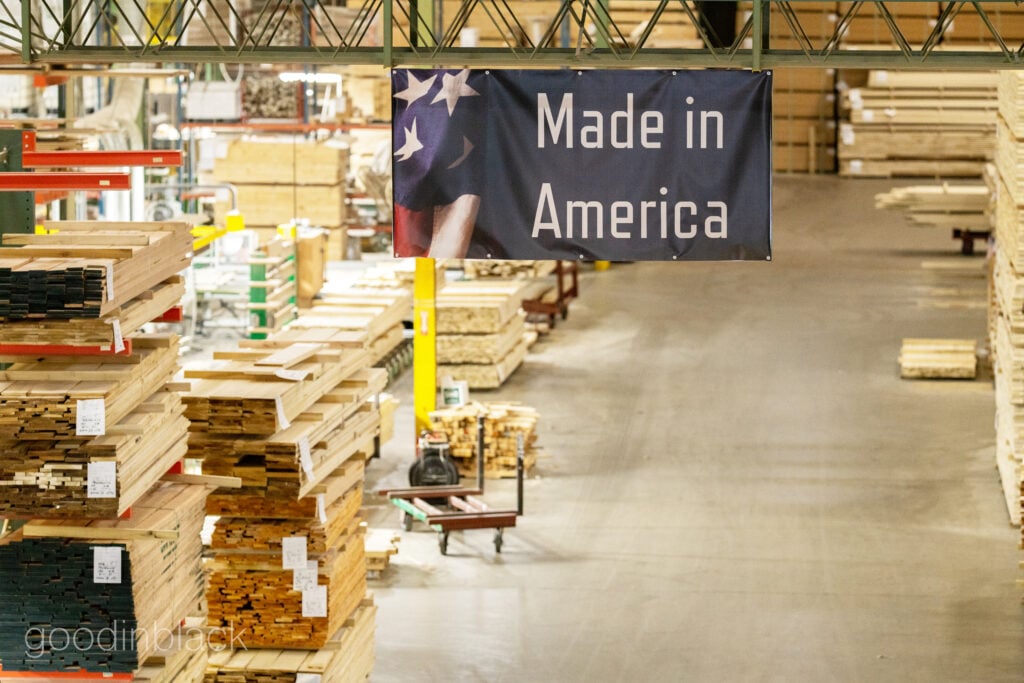
Domestic production enables Koetter to respond quickly to
custom and time-sensitive orders.
He summarized the company’s operational identity in simple terms. “We control the process from start to finish.”
Koetter Woodworking’s evolution has been fueled by reinvestment, but Koetter makes a point of framing those decisions as tools serving a larger goal rather than trophies.
In recent years, the company has continued investing in state-of-the-art equipment, including a major upcoming press installation. “We’re going to continue to invest in equipment,” Koetter said. “We have a planned installation of a Profi Press glue system in 2026 as part of our long-term equipment strategy.”
Koetter also highlighted the company’s ongoing equipment modernization, including forklifts transitioning toward electric. Those steps align with the company’s preference to control its own capability rather than relying on outside resources to create consistency.
Still, Koetter said reinvestment is meaningless without people. “Again, none of it matters without the right team in place,” he said.
Koetter’s sustainability approach is not presented as a marketing language. Instead, Koetter linked it to generational thinking and practical stewardship.
Koetter said that going back into the 1990s, his dad and uncles planted about 50,000 saplings per year. The company would take farm ground with erosion concerns and restore it into forest. “We’ve got about 1,000 acres around our plant,” Koetter said, describing the scale of the effort. “Those properties were restored back to managed forestland.”
Koetter described that work as both practical and symbolic. “It reflects a long-term mindset — investing in something you may never personally benefit from,” he said. “Dad was passionate about that.”
Koetter said the company continues similar practices today, working with a local district forester to manage company properties responsibly. The company also uses this stewardship as a relationship tool with customers.
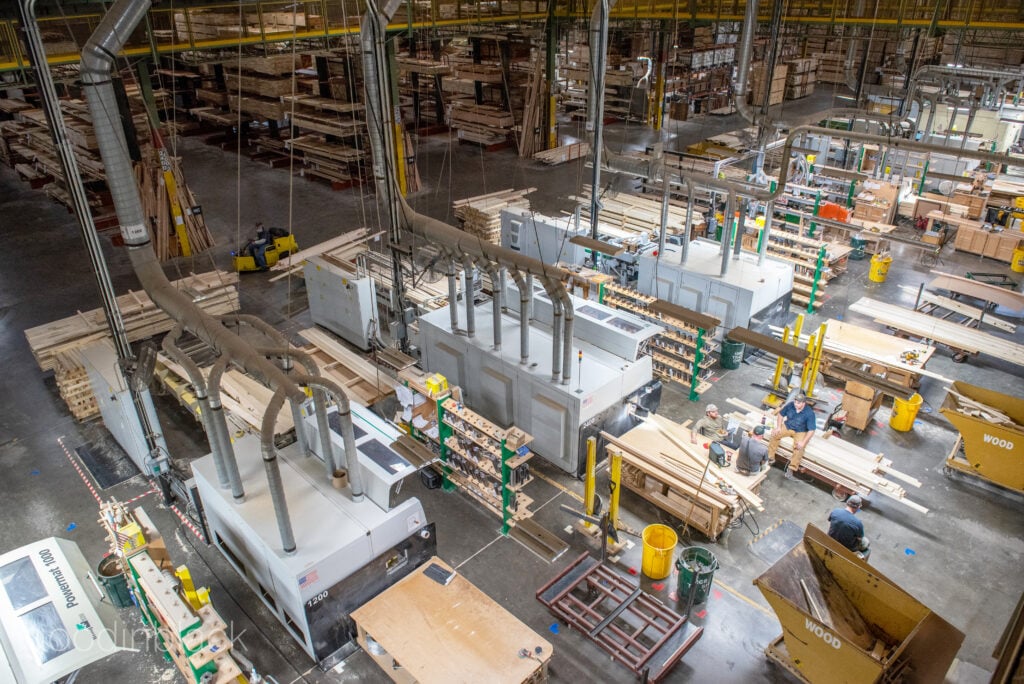
Weinig equipment plays a central role in Koetter’s ongoing
equipment modernization strategy.
“When customers visit, we often take them out on side-by-sides through our woods. It’s a relaxed environment where we can talk about how we operate and the people behind the work.”
While Koetter continues to expand and modernize its operation, Koetter is clear that the company’s biggest work is not only equipment purchases or facility improvements. It is building the third generation with the same mindset that built the second.
“The future of the company is centered on engaging the third generation and continuing our family-led approach.” Koetter said, noting the company is actively working on that transition now. He said family members are already involved full time.
When asked about the biggest future investments, Koetter did not point first to machines. Instead, he described leadership development. “Our biggest focus over the next few years is developing the third generation,” he said, “and passing along the values of leadership and trust.”
That is, in Koetter’s view, the true reinvestment. “This next generation really understands the value of reinvesting in the team,” he said. “So that’s probably our biggest project over the next couple of years.”
In a market where change is constant and competition never sleeps, Koetter Woodworking has chosen a durable strategy: reinvest in what can be controlled, train people who can execute, and keep the company’s values intact so the business can keep building. For Koetter, the method is simple, but not easy: deliver on time, deliver quality, and never lose sight of the people behind the work.
Association memberships include the American Institute of Architects, Architectural Woodworking Institute, Indiana Hardwood Lumberman’s Association, Kentucky Forest Industries Association, National Association of Home Builders, Building & Development Association of Southern Indiana, Building Industry Association of Greater Louisville, and the Real American Hardwood Coalition.
For more information, visit koetterwoodworking.com.