How The Contracting Hardwood Industry Is Impacting Wood Tie & Freight Rail Supply Chains
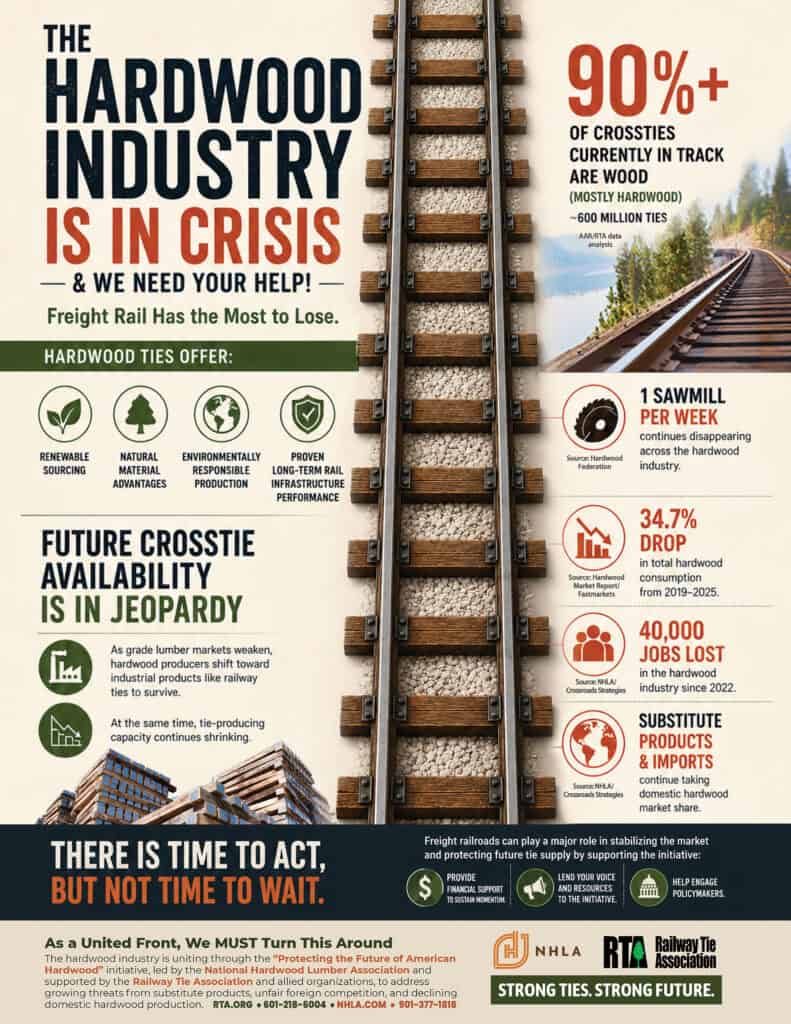
Wood crossties account for more than 90 percent (~600 million) of ties installed in North
American freight railroad track and remain the most practical, sustainable, and economical solution for freight railroads. However, hardwood industry challenges are creating concerns for the long-term stability of the wood tie market.

As substitute products, foreign competition, and declining demand continue pressuring traditional hardwood markets, many hardwood sawmills are facing increasing financial strain. At the same time, the wood tie market is dealing with an inventory-to-sales ratio (ISR) of 1.02, with purchases and inventory essentially equal. Because wood ties generally require eight to 10 months of drying time before they can be treated on a dry basis, current inventories are likely masking longer-term supply concerns as mills continue slowing production or shutting down.
Hardwood sawmills depend on selling all parts of the log to remain profitable. When demand and pricing weaken across other hardwood markets, it becomes much harder for mills to stay open and manufacture wood crossties. While wood tie inventories may appear sufficient today, continued sawmill closures are reducing the number of facilities capable of producing hardwood ties in the future.
According to Hardwood Market Report/Fastmarkets, total consumption of hardwood lumber by domestic markets in 2025 was 2.9 billion board feet lower than in 2019 and 7.5 billion board feet lower than the peak 1999 total, contributing to the loss of tens of thousands of jobs. If broader hardwood markets do not improve, additional mill closures are likely to tighten future wood tie supply and make sourcing of one of the freight rail industry’s most important, economical, and sustainable infrastructure components much more difficult.
The hardwood industry is coming together to address challenges to domestic hardwood production, including hardwood ties, through the “Protecting the Future of American Hardwood” initiative. Led by the National Hardwood Lumber Association and supported by the Railway Tie Association (RTA) and other allied organizations, the hardwood industry is strategically collaborating to save itself from substitute product threats and unfair foreign production that is structurally collapsing our ability to compete domestically.
RTA is actively involved, working with industry partners to help shape strategy, support messaging, provide financial and in-kind support, and engage policymakers and railroads in this long-term strategy.
The Hardwood Industry Is In A Crisis, And It Did Not Happen Overnight
• The domestic hardwood industry has been declining for years:
• 35 sawmill closures in 2025 alone.
• 40,000 jobs lost since 2022.
• $390M in annual lost revenue.
• 29% drop in hardwood production.
• Wood substitutes are rapidly gaining market share.
• Production is moving offshore, with China, Vietnam, and others effectively dismantling the hardwood industry one deliberate step at a time.
Conceptually, our industry has two primary combatants: substitute products and unfair foreign competition.
For decades we have seen the loss of market share in legacy hardwood-dominant segments: solid wood flooring, solid wood cabinetry, solid wood furniture and solid wood moulding/trim work, and so-on, respectively (not to mention the great conversion of dominantly hardwood pallets to softwood pallets…).
Non-wood, or wood composite substitutes, have steadily gained ground in those segments and have led to a loss of many options for our domestic hardwood producers. And near the great recession of 2007-2009, our domestic hardwood producers also experienced a paradigm shift in hardwood product outlets: from “grade” to “industrials” like mat timbers, pallet cants, ties and timbers. During that time, we lost dozens, maybe hundreds, of domestic hardwood sawmills to the recession alone, plus the onslaught of disappearing hardwood commodities to non-wood replacements, i.e. substitute products.
Concurrently, we saw feverish activity from China and Vietnam to buy both finished and raw hardwood products coming out of the great recession and continuing today. That has only increased, comparably—although sometimes hot, sometimes cold—but has been linear to our domestic production contraction, overall. Foreign producers buy U.S. logs, ship them via container overseas, manufacture products out of them, and sometimes even sell them back to U.S. customers, and the balance is sold abroad, limiting our producers the opportunity. The ability of those entities to do this profitably is based on non-equal (to U.S.) labor and input costs, as well as government/operation regulations—or lack thereof. Many have recently reported on large China-owned, yet operating within Vietnam, new hardwood sawmills in operation. With the current administration in favor of onshoring, we have an opportunity now to impact at the highest level, but our messages need to be unified and disciplined.
How This Applies To The Long-Term Sustainability Of Railroad Track Infrastructure
• Hardwood tie supply depends on a healthy, sustainable hardwood market.
• When mills slow or shutter, tie supply tightens, reducing long-term capacity.
• Once that capacity is gone, it is not likely to come back.
The Initiative’s Areas Of Influence
• Lobbying the legislature.
• Lobbying the administration.
• Urging government procurement to require domestically produced hardwood products in government sourcing: structural, furnishings, etc.
• Political contributions and coalition building.
How You Can Provide Resources & Lend Your Voice
• Support the “Protecting the Future of American Hardwood” effort:
o Provide financial and/or in-kind support to gain and retain momentum: A winning campaign requires about $500,000 annually across lobbying, political influence, and public affairs to credibly compete at a high level.
o Engage in policy discussions with industry partners and invite officials to your facility or industry-related meetings.
o Help tell the hardwood and wood tie story, reinforcing the importance of wood ties to the long-term sustainability, efficiency and safety of America’s freight railroads.
• Think long-term in procurement and supply decisions.
The long-term availability of hardwood ties depends on the health of the domestic hardwood industry. Without immediate action on your part, the current trends will lead to tighter wood tie supply and higher costs. However, with engagement from freight rail and industry partners, there is still time to turn this around and balance the scales.
To learn more or get involved, contact Dr. Nate Irby, Ph.D., at nirby@rta.org or (770) 460-5553.