The SLB Is Removing Barriers to More Wood Construction
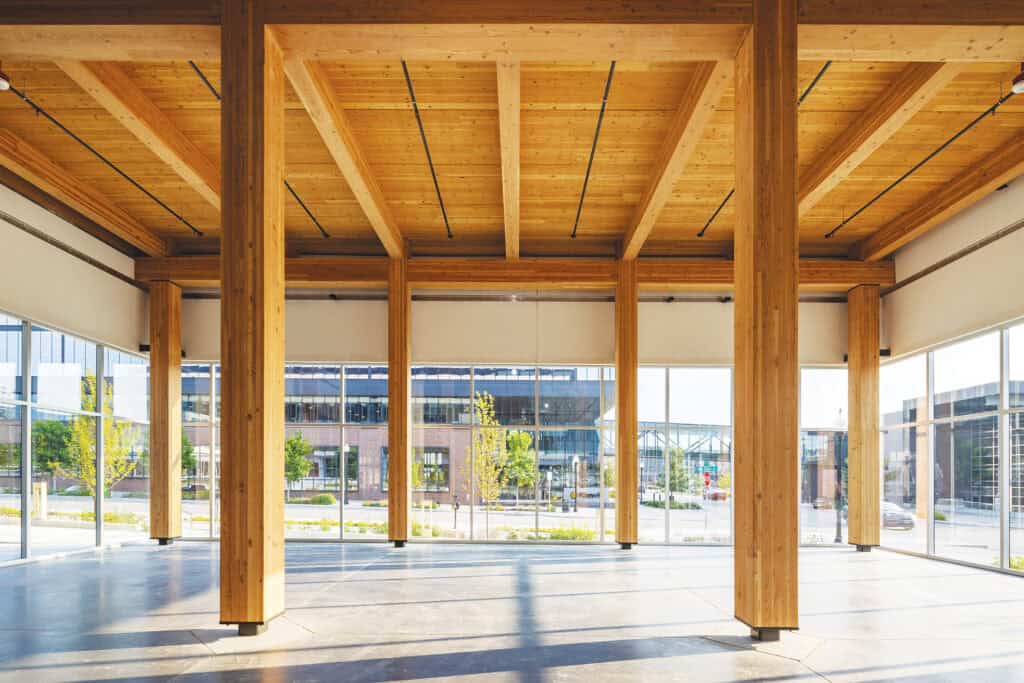
1501 Mike Fahey | Photo: Dan Schwalm
Architects, engineers, contractors, and developers surveyed this year by the Softwood Lumber Board reported higher awareness of nearly every wood building application than they did five years ago. Unfamiliarity with wood construction opportunities is becoming less of a barrier to lumber demand growth.
That result reflects years of work addressing the practical obstacles that can keep wood out of projects—from building code limitations and unfamiliarity among project teams to cost perceptions and construction challenges. The survey also shows which obstacles remain.
The research comes as the SLB pursues its strategy to generate 2.9 billion board feet of incremental annual lumber demand by 2035. Reaching that goal will require not only targeting the construction sectors with the greatest growth potential, but systematically removing the barriers that prevent wood from capturing a larger share of those markets.
The SLB funds this work through four programs: the American Wood Council (codes and standards), WoodWorks (direct project support and conversions), Think Wood (communications), and SLB Education (wood design education at colleges and universities).
Meeting the SLB’s ambitious growth goals requires continuing effort to overcome the obstacles to wood specification that remain—and the SLB and its funded programs are honing their strategies to identify and overcome these challenges.
Building code development expands where wood can compete
The AWC has made significant progress in developing codes and standards friendly to wood construction. But issues related to building codes, such as fire codes, restrictions on wood building heights, and adoption of updated mass timber codes, remain obstacles for some design and construction teams, demonstrating the need for the work to continue.
The AWC achieved important wins for the lumber industry in the 2027 I-code cycle, protecting lumber’s standing in construction and preserving new opportunities for expanded use nationwide. These outcomes matter because model codes establish the legal pathways that states and local jurisdictions rely on when approving building systems. The AWC is also making continued progress toward broader nationwide adoption of mass timber building code provisions, with adoption in 31 states and by local jurisdictions in 14 more.
Design and construction support makes wood easier to choose
The perception that wood costs more remains a barrier. SLB-funded programs address it by demonstrating the value of wood construction and educating project teams on the factors beyond material cost, such as schedule, foundation size and weight, and labor, that drive the total cost of a project.
WoodWorks provides direct technical support to project teams, helping them resolve issues such as jurisdictional approvals or complex detailing. Its Construction Management team works closely with general contractors on system coordination, erection logistics, and bid preparation—all of which can give more GCs the confidence to bid on wood construction projects and deliver wood’s construction schedule advantages.
Expanding the pool of contractors equipped to competitively bid and efficiently build wood projects is critical to scaling wood construction: Even when a design team wants to use wood, limited contractor experience can translate into higher bids, larger contingencies, and ultimately a switch to another structural system.
On larger commercial and institutional projects, the decision increasingly depends on more than construction cost alone. Developers need evidence about the economics of the completed asset. Some of the earliest U.S. mass timber buildings have enough history to provide that evidence through sales, valuations, and leasing performance. An SLB-funded study is analyzing those results to give developers real-world data for evaluating mass timber’s potential return on investment.
The next barriers: New markets, insurance, and risk
The SLB is also applying the approach to emerging market segments. In the fast-growing industrial and data center market, new research is identifying the technical, economic, and market obstacles that currently limit wood use—and where targeted industry investment could unlock additional demand.
The SLB is also investing to overcome concerns about material durability and insurance availability. Insurance concerns are partly driven by perceived or actual risk, and addressing the underlying risk can help address the insurance barrier. Building on the success of the Mass Timber Insurance Playbook developed in partnership with the Alliance for Sustainable Building Products (ASBP), the SLB is partnering again with the ASBP on a resource for managing water and moisture risk throughout the lifecycle of mass timber buildings—helping address one of the issues that can affect insurer confidence in mass timber projects.
Increased awareness of nearly all wood building applications is an encouraging measure of how much wood design and construction has entered the mainstream. But reaching the SLB’s 2.9 BBF growth target requires continual progress to remove the obstacles that still stand between a project team’s interest in wood and a decision to build with it.
That is the role the lumber industry created the SLB to play. As a primary funder of WoodWorks and the AWC and the sole funder of Think Wood and SLB Education, the SLB coordinates investments across the market-development spectrum—establishing code pathways, supporting design and construction, and building the knowledge that leads to specification. Removing barriers systematically is how the industry turns potential wood projects into lumber demand.